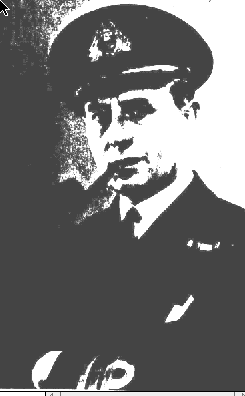
Captain Peter Behague, OBE, DSC RN, came into my life like a thunderclap in 1949 when I worked in Singapore. I was then a journalist with the Straits Times. He was Chief Staff Officer, HMS Terror, Singapore Naval Base. I had written a critical article for my paper under my name. He had no idea there were other Behagues in the world apart from his own small enclave. He demanded to know who the blazing fury this intruder was - and thus began a long and cordial relationship which lasted until his death in 1982.
Born an Alfred, he preferred to be called Peter, and was a meticulous, spry, bright-eyed man with a salty tongue, a high spirit of adventure and an unquenchable love of the sea. He once told me that the Woolwich Ferry which plied across the Thames between Woolwich and the East Ham docks was his undoing. It fascinated him as a boy, and since it was a free ferry he spent many hours travelling backwards and forwards on it observing the swirls and currents of the river and admiring the skills of the crew.
In 1915, on his 18th birthday, he was accepted for a 12-year term with the Royal Navy starting as a Boy Second Class rating. Little did he realise then that he was destined to make the navy his career, would win high honours, and be one of the few "boys" to gain the coveted rank of captain. After initial training he joined HMS Impregnable at Devonport, where life was tough and spartan and left him with a loathing for apricot jam, which was served with most meals.
He wrote home to comment "My pocket money is only 6d a week with one bar of chocolate and no stamp."
After being made up to Boy First Class in 1916 he was drafted to his first sea-going ship, the SS Hildebrand, a passenger vessel belonging to Booth Line which was acting as an armed merchant cruiser attached to the 10th Cruiser Squadron.
That, briefly, was how he was launched and where we now pause to look into his ditty box. It's strange the odd things one clings to over the years. Captain Behague died in Western Australia in 1982 and when, recently, his daughter Ann began to sort out his bits and pieces she came across a ditty box which was full of letters, papers and journals, together with his old school cap and football jersey.
What on earth to do with a lifetime of memorabilia? Ann had tearfully to discard much of it, but bravely set out to arrange the rest in chronological order, binding them into two fascinating volumes of one sailor's life with copies for family and friends. They make lively reading.
One of the first documents to come to light was a certificate reading "Paid 7s. 4d. for destruction of submarine UC49." To find out more, the Ministry of Defence, Naval Staff Duties (Historical Section) was contacted, and the reply was as follows:
"Captain Behague's award of 7s. 4d. for the destruction of UC49 was bounty or 'head money' paid for the destruction of enemy warships and analogous to Prize Money. Initially introduced to counter Prize Money, which tended to cause preferment of trade capture over engaging the enemy, the bounty was based on the number of crew on board the enemy ship. During the period 1914-1918 the scheme was extended by the award of fixed sums (usually £500 or £1,000) to crews of ships believed to have sunk submarines. Royal Naval officers were excluded, only Royal Naval Reserve and Royal Naval Volunteer Reserve and ratings benefiting on a 'share' basis. Awards were made, sometimes long afterwards, as the notation on the certificate shows".
It was August 1917 and Seaman Behague was serving in the patrol destroyer HMS Opossum at the time. Payment was not made until February, 1923, and the war had been over for several years. The silent service can often be remarkably slow in coughing up.
The UC49 was the last U-boat to be sunk in the Channel at the end of the Great War. Engaged in mine laying off Start Point it fouled one of its own mines and there was an explosion. Opossum heard the blast and began looking for the U-boat with sweeps and hydrophones. Captain Kukenthal, commander of the UC49, started his motors when he thought he was safe but Opossum was on to him and dropped several depth charges. Kukenthal stayed at the bottom and Opossum withdrew noisily to a spot a couple of miles away in an attempt to outfox the UC49.
After two and a half hours of lying low the U-boat broke surface, then surprisingly and quickly began to sink, bow down at a 50 degree angle. Opossum dashed to the scene, let loose more depth charges and was rewarded with the sight of oil and bubbles. A sweeper located the wreck the next day and final confirmation came with the appearance of an electric light bulb made in Vienna.
In February, 1923, Leading Seaman Behague was posted to the battleship HMS Valiant. It was a profitable year, and he won the Arbuthnot Trophy for prowess on an 8 hp autocycle and gained his Highest Education Certificate First Class, scoring 94 marks for navigation, reckoned to be highly creditable.
Late in 1924 he was promoted to Acting Mate and went on a mate's course at the Royal Naval College, Greenwich. In the following January fate in the shape of Muriel Mary West was awaiting him at a dance and they were married in December. I mention this because among the Captain's precious bits and pieces are the ticket to the dance at the Holborn Hall, London, together with a letter from Muriel West accepting his invitation to attend. They were so formal in those days. There is a note beneath the marriage certificate which reads "The beginning of 43 years of happy married life, in spite of many and long separations". It was not much fun, however, to be a sailor's wife in those demanding days.