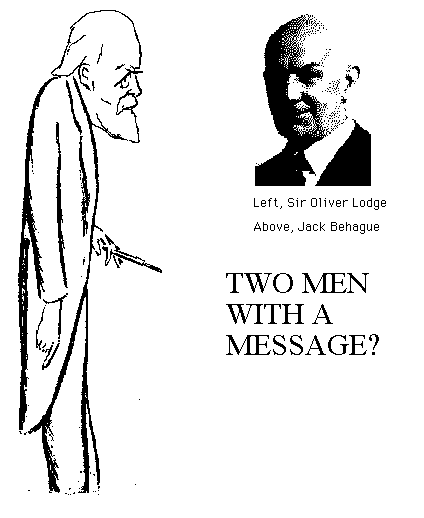
My father, Jack Russell Behague, worked for the two sons of Sir Oliver Lodge, Noel and Lionel, at the Birmingham engineering firm of Lodge-Cottrell, and often spoke of them and the pioneering work of Sir Oliver with warmth and enthusiasm. Lodge was a fascinating man - distinguished physicist, inventor, mathematician, author and investigator. He did valuable research into the fields of electromagnetism and wireless communications and was also a leading psychical researcher.
My father's work as Chief Engineer at Lodge-Cottrell was principally concerned with the design of electrical precipitation plants for power stations. Sir Oliver, during experiments into the effect of high voltages on dust particles, had discovered that it was possible not only to reduce atmospheric pollution but recover valuable metals from industrial emissions as well. He passed on the findings to his sons who formed the firm together with an American named Cottrell. It proved very successful right from the start, and today Lodge's invention, helped by improvements and patents created by my own father, is playing an important part in the battle against pollution.
Research into survival
It seems strange that Sir Oliver's ventures into a world far removed from mathematics and cold logic should be more widely remembered than his scientific papers to the Royal Society or his work on electrolysis, X-rays, storage batteries and electrical induction, but there is no doubt that his research into the survival of life after death and his efforts to unite science with religion caught the attention of millions and still fascinates many people.
When Lionel Lodge was dying with cancer in Birmingham, he seemed far from dismayed, and told my father that Sir Oliver (who died in 1940) had forecast at a seance that when he, Lionel, witnessed his own funeral he would be reduced to laughter at the sight of so many solemn faces.
In the thirties Sir Oliver Lodge was acknowledged to be one of the great personalities of Britain - alongside those of Churchill and Shaw - and was called a prince of broadcasters. Despite long treatises in learned journals he also wrote for the popular press, and there were regular articles on a wealth of topics in the Sunday Graphic, the Sunday Express, Popular Wireless, even Titbits. He was a joy to any journalist in search of interesting copy, and all it required was a telephone call to turn him on like a tap. Some of his stuffier colleagues thought he had lowered and cheapened himself through such easy accessibility and down-to-earth writings, but he gained a massive audience of ordinary people and received hundreds of letters.
Lodge had the ability to make the most obscure subjects sound interesting, he possessed a rare wit and vitality. He gave many lectures in Britain and America, all fully booked, and his broadcasts on history, philosophy and science were received with acclaim. If he lived today he would be a world figure of enormous stature and be constantly in the headlines.
Fascinating reading
What he said and wrote half a century ago still makes fascinating reading today.
On life after death. "I assert that it is possible to get into telepathic communication with those who have survived the death of the body. Their mind, their character, their personality, persists... It is not easy to say all this, for it is not a thing to be said lightly. I only say it on the strength of a great body of evidence, now known to me and to many others. Either it is true or false. If it is true, it is difficult to overate its tremendous importance.
"Experiment in such matters is resented both by the scientific and the religious world. There are still unpopular branches of enquiry; there still seem to be subjects into which we are forbidden to look. The old gauntlet of ridicule and opposition has still to be run.
"I expect that before long some of the younger members of the scientific fraternity, not only physicists but biologists also, will open their minds to unsuspecting possibilities, and in process of time will construct a splendid edifice on the gropings and hesitations and incredible assertions of the past."
On ghosts. "Mental impressions can already be stored in matter, by such instruments as the gramophone and the photographic plate. There are some who think that violent emotion can be likewise unconsciously stored in matter; so that a room where a tragedy has occurred shall exert an influence on the next generation, or rather on anyone sufficiently sensitive to feel it."
On predictions. "We know that prediction is possible in the inorganic world, especially in the simplified motions studied in astonomy; and it may be assumed that a wider knowledge, say of the motion of molecules and of the stucture of matter, might enable us to foresee those cataclysmic changes which we commonly call accidents, and thus to anticipate disasters and convulsions of nature before there are any normal indications."
The mind. Mind utilizes and dominates matter; it uses it for purposes of demonstration and achievement, employs it as a vehicle of manifestation, but it is a deadly mistake to identify thought and personality with any assemblage of atoms.
"Those who have limited themselves to a material view of existence, and closed their eyes to reality, necessarily take a very low and limited view of human destiny, and think the idea of survival nonsense. If the brain is the mind, if all memory is stored there, if it is not only the instrument for reproducing and manifesting thoughts and ideas, but is the actual human being - a strange notion - then indeed we are feeble ephemeral creatures, living our thousand months and then returning to the dust whence we came. A futile sport, without permanence, without meaning. All our hope and faith and charity, all our joy and sorrow and self-sacrifice, going for nothing, blotted out and ceasing as a tale that is told."
Sir Oliver: "Mankind is barely civilized as yet." Immortality. "The truth is that we ourselves are not subject to mortality, that we do not decay or wear out, that we have a permanent existance beyond the life of the material fleshy organism which we inherited from the rest of the animal creation."
The future. "Mankind is barely civilized as yet, we have much leeway to make up; but there is plenty of time. For the individual and also for the race there is a magnificent prospect ahead."
Sir Oliver could also be outspoken and critical. Addressing a meeting of the National Union of Women Workers in 1901 he said: "I much fear that in some London hospitals the probationary nurses are being worked much too hard, worked too hard and fed too badly in some cases. Their enthusiasm and self-abnegation are exploited; it is an abominable shame and demands an inquiry."
Some might say that, ninety years later, things haven't changed all that much.
A crusader for hydro-electric power, he would have delighted the Green Party. "We degrade," he said, "a large population to the most loathsome labour in the pits, we consume and poison the air, we load it with such quantities of smoke that the sun is barely visible... if only we can find some means of leaving the atmosphere alone, and not polluting it even more than we now do the rivers." What would Lodge have said today?
Footnote: When Lodge realised he hadn't much time left he arranged what he called his "Posthumous Packet". This consisted of seven sealed envelopes adding up to a message known only to himself. After death he proposed to make contact, reveal the contents, and thus prove survival a fact. The whole business was rather complicated. After Sir Oliver's death some mediums claimed to have been given the sense of the message. One or two came quite close but on the whole the experiment was judged inconclusive.
As for Jack Behague, dedicated engineer, who devoted a great deal of his life to Lodge Cottrell Ltd., he retired at 70 and spent the rest of his life gently pottering, spoiling grandchildren, solving people's problems and trying to find the remedy for chronic arthritis.
In his kitchen at Shenstone, in Staffordshire, was a large clock in the shape of a barrel which came from the board room of Lodge's, and only needed to be wound up once a month. For some reason, which he never disclosed, the clock meant a great deal to him. When Dad died at the age of 88 in the Good Hope Hospital, Sutton Coldfield, the clock (fully wound) stopped at 2.45 a.m., the precise moment of his departure.
In his small way, Jack Behague left a far more convincing message about survival than Sir Oliver himself.