Why only a short history? Because there are many gaps waiting to be filled in the story of our ancestors' struggle to establish themselves in Britain, and there is such a dearth of information about their actual roots across the channel. I can only hope that some future Behague with a burning respect for the name he or she bears, and a fascination for our beginnings, will take the plunge and complete the picture.
For many years the name Behague was a pain to me, often when people failed to pronounce it properly, and especially when a teacher deliberately mispronounced it Behave. This was picked up by the entire class and they made my life a misery.
The name did not really come into its own for me until I joined the BBC in 1963. On my first day in Broadcasting House I was introduced to one of the secretaries, a Frenchman named Maurice Le France, who went into raptures over my "illustrious ancestors" and promised to supply the details.
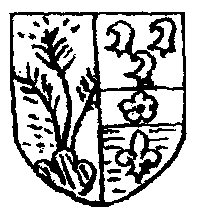
He was as good as his word. After consulting the Dictionnaire de la Noblesse Francaise and other sources he handed me a sheet of paper containing the family motto and an illustration of the Behague coat of arms. The motto is as follows:
"Bon guet chasse male aventure"
Translated this means: "Careful watching chases misfortune away."
Believe me, it is as good a motto as you'll find anywhere.
Below is the coat of arms as Maurice Le France actually copied it with a spluttery pen in the British Libray reading room after finding it in the guide to the French aristocracy.
And this is what he wrote beneath it:
Arms: Party per Pale (A) Or, three ears of wheat vert issuing from a mount of the same. (B) Party per fess, in chief vert, three eagles' heads erased argent. In point azure a fleur-de-lys or; on a chief argent a rose gules. The fleur-de-lys was granted by Mary of Burgundy for services rendered.
(Be warned, there are variations to the above in other documents unearthed, and I much prefer the version reproduced at the start of this short history.)
Maurice's summary:
Behague, a noble family of the Low Countries divided into several branches, some in Germany, some in France, some in the Netherlands and Belgium. They are mentioned in the 15th century when one of the founders served Mary of Burgundy, Countess of Flanders and later Empress of Maximillian of Austria.
There is mention in one unauthenticated document of a Mssr. Behague from La Rochelle, member of the family of the Counts of Burgundy, arriving in this country (possibly in Rye) in 1572, and saying: "I might have kept my titles if I had sacrificed my convictions".
In another document there is a report of 1,500 refugees, including 140 noblemen and 144 lawyers and doctors, joining the English Army. Among them were many Huguenots including Marshal Schomberg who fought as commander-in-chief for William of Orange in the Battle of the Boyne, and was killed together with a Count Behague.
Following the noble line, there is a lot of information about the wealthy Countess de Behague, who lived in France from 1870 to 1939 and possessed a fabulous collection of art treasures. More about her later. Much earlier, Jean Pierre Antoine Count de Behague, a French general, became Governor of Martinique. That was in 1792. A Felix Louis Behague, who was born in Lille in 1767, was a renowned artist of the French School and a pupil of Vincent.
Those early Behagues had a lot of get up and go!